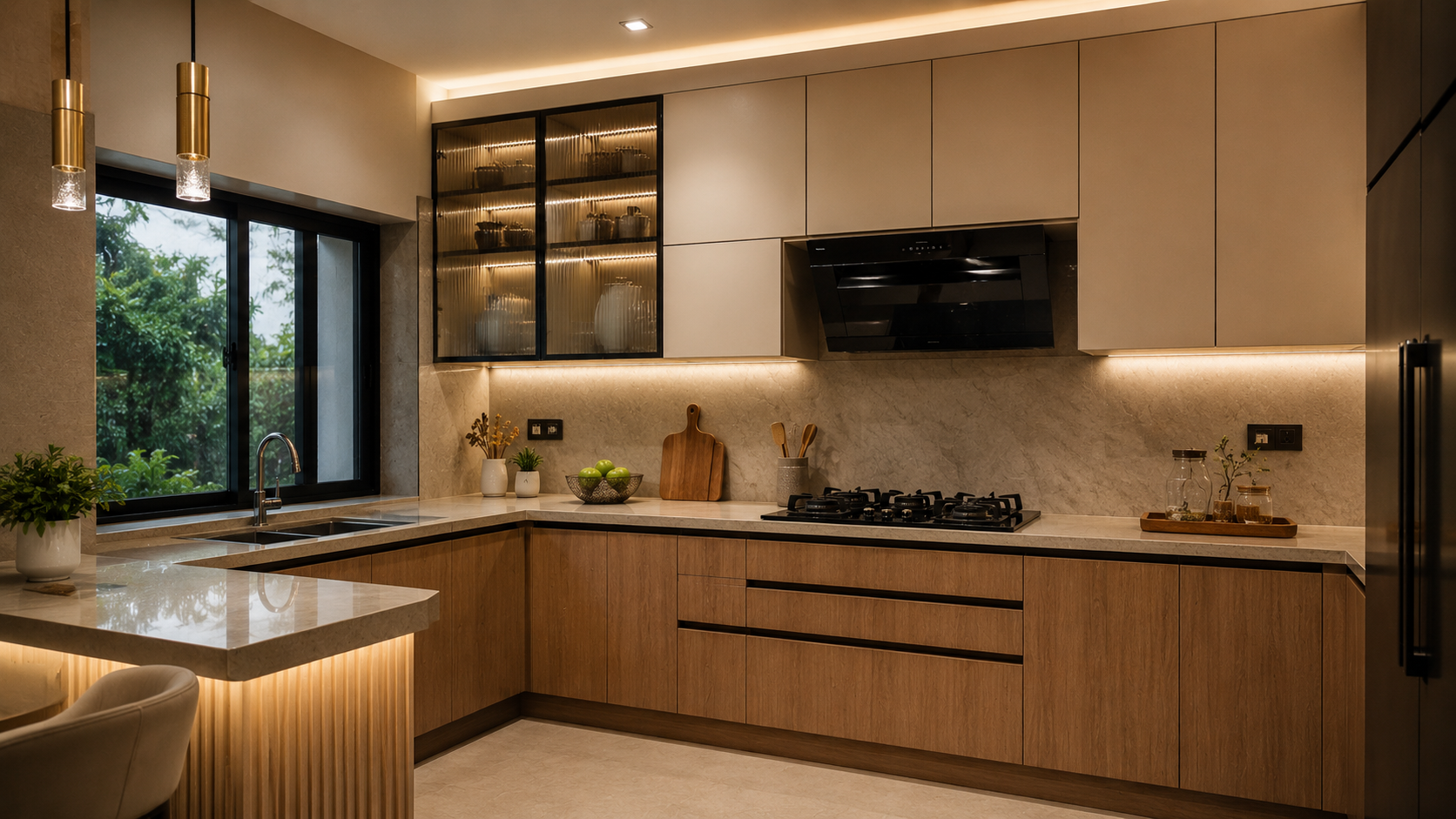
Modular Kitchen Materials Explained: Why Virgin Laminate Matters and What to Avoid
Modular Kitchen Materials Explained: Why Virgin Laminate Matters and What to Avoid
You finally get your dream modular kitchen installed. It looks stunning on day one. Then, two years in, the cabinet edges start peeling. A corner near the sink turns pale. The shutter surfaces bubble up in the humid Kerala summer.
You didn't buy the cheapest kitchen. So why is it failing?
The answer, almost always, is the laminate.
Most buyers focus on the cabinet design, the hardware or the finish colour. Very few ask what the laminate is actually made of. That single oversight can cost you a full kitchen replacement in under five years.
Let's fix that today.
A kitchen works hard every single day. It faces steam, spills, heat and fast cleaning. That is why the real quality of a modular kitchen shows up only after months of use. Thomar Interiors places a clear focus on premium materials, in house factory work, German machinery, AI assisted design and a “Virgin Laminate Guarantee,” which makes this topic especially worth understanding before you buy.
What Is Laminate And Why Does It Cover Your Kitchen?
Laminate is the thin, hard sheet bonded to the surface of your modular kitchen shutters and panels. It protects the substrate underneath, usually plywood or MDF, from heat, moisture, scratches and daily wear.
It determines how your kitchen looks. It also determines how long that look lasts.
Good laminate feels smooth and dense. Poor laminate looks fine for the first year. After that, it starts telling you exactly what it's made of.
What Virgin Laminate Really Means in a Modular Kitchen
In Thomar’s own words, its modular factory uses “100% virgin laminate paper” and backs it with a Virgin Laminate Guarantee. The brand also highlights E1 boards, premium materials and controlled factory production. For a buyer that is more than a label. It points to a build that starts with fresh material, tighter quality control and a more predictable finish.
That matters because a kitchen is not judged by looks alone. It is judged by how the surface ages, how the edges hold up and how clean the finish stays after daily use. Thomar’s Bangalore page also frames the material choice clearly: the cost gap often comes down to core material, finish and hardware. That is exactly where many buyers lose value without noticing.
Virgin Laminate vs Recycled Laminate: The Core Difference
Here's what most vendors won't tell you upfront.
Laminates are made using melamine resin and paper layers pressed under heat. Virgin laminate uses fresh, unprocessed raw materials in every layer. Nothing is recycled. Nothing is reused. The chemical bonding is complete and consistent throughout.
Recycled or low grade laminates are different. They use leftover or reprocessed materials. The density is uneven. The resin saturation is poor. Visually, you can't tell the difference on day one. But the material has weak spots — and your kitchen will find them.
The results show up as:
- Edge peeling — especially near corners and handles
- Moisture absorption — leading to swelling and delamination in humid climates
- Surface discolouration — fading unevenly over time
- Structural weakening — the bond between laminate and substrate breaks down
In a coastal or humid environment like Kerala, these problems don't take long to appear.
Why Cheap Kitchen Cabinet Laminates Fail Early
The biggest enemy of laminate is water at the wrong place. Laminate care guides warn not to flood the surface, especially near seams, because water can enter and swell the substrate. They also advise using mild cleaners and nonabrasive cloths, since harsh products can damage the wear layer. In a kitchen that means the weakest spots are usually the sink zone, the edge joints and any cut out near heat or splash.
This is why a low price kitchen can look fine on day one, then begin to peel, dull or swell later. The problem often does not begin on the face of the panel. It begins where the finish meets moisture, steam or poor sealing. Once that happens, the damage spreads fast and repair becomes harder than the original saving.
The Materials That Deserve More Attention
When you choose modular kitchen materials, do not stop at the colour chart. Ask what lies beneath the finish. Thomar’s own content stresses in house factory control, transparent pricing and durable finishes. Its Bangalore kitchen page also highlights smart storage, durable finishes, easy maintenance and ergonomic layouts for daily use. That is the right way to think about a kitchen: not as furniture, but as a working system.
The board core matters. The finish matters. The hardware matters. Thomar’s 2026 guidance for home interiors even calls out the need to compare plywood against cheaper MDF, simple laminate against premium acrylic and branded hinges against weak fittings. Those questions may sound basic, but they are the difference between a kitchen that lasts and one that frustrates you later.
Why Kerala Kitchens Demand Better Laminate
Kerala homes deal with some of India's most demanding interior conditions. High humidity is constant. Kitchens face steam, cooking heat and frequent water exposure near the sink zone.
Moisture resistant laminate isn't a luxury here. It's a basic requirement.
And yet, many interior firms still use recycled or B grade laminates to cut costs — without telling the client. The finish looks identical at installation. The price looks attractive on paper. The problems come later, after your warranty period conveniently ends.
This is exactly what makes the Virgin Laminate Guarantee from THOMAR Interiors a meaningful differentiator — not just marketing language.
What to Avoid When Buying a Modular Kitchen
Avoid vague material claims. If a seller cannot explain the board type, the laminate grade and the sealing method that is a warning sign. Thomar’s own process relies on site assessment, 2D and 3D design, factory production, quality inspection and after sales support. That process works because each step reduces guesswork before the kitchen reaches your home.
Avoid surfaces that promise style but ignore daily care. A kitchen should resist moisture, but it should also be easy to clean. Thomar says its modular kitchens are planned for Indian cooking habits, with smart storage, durable finishes, easy upkeep and ergonomic layouts. That is a practical benchmark. If a product cannot handle daily cooking mess, it is not a true kitchen material choice.
Avoid unclear post-handover support too. Thomar highlights a dedicated after sales system through Thomar Home Care, along with lifetime service support and punctual delivery on its main site. That matters because even a good kitchen may need adjustment after use. Good support protects the value of the whole project.
THOMAR's Virgin Laminate Guarantee: What It Actually Means
THOMAR Interiors, one of South India's most respected interior brands, explicitly commits to using 100% virgin laminate across all their modular work. It's a core factory standard right alongside their German machinery, expert craftsmanship and global quality benchmarks.
This isn't a claim you have to take on faith. Their factory in Kerala produces every component in house, under direct quality control. There's no subcontracting, no material substitution mid project. What you see in the specification is what goes into your kitchen.
For a quality conscious buyer, this matters enormously. You're not just paying for aesthetics. You're paying for laminate durability that will hold up through years of real kitchen use.
Three Material Failures to Avoid in High Pressure Laminates
A quality kitchen must endure harsh daily conditions. To protect your investment, you must avoid three classic material failures.
1. Peeling and Splitting Edges
Cabinet corners take the hardest beating. Cheap laminates are stiff and brittle. When bent around doors, they suffer micro cracks. Over time, cheap glue fails and edges peel back like old stickers. You need premium edge banding sealed with waterproof adhesives to prevent this.
2. Moisture Swelling and Core Rot
Kitchens are wet spaces. Water from your sink easily sneaks past low grade surfaces. If your laminate is porous, the wood beneath sucks up water like a sponge. This destroys moisture resistance. The cabinet doors swell, lose shape and refuse to close properly.
3. Ugly Yellowing and Heat Stains
Have you ever seen white cabinets turn a sickly yellow? That is the result of cheap melamine resins reacting to sunlight and stove heat. Impure resins degrade rapidly under ultraviolet rays. Premium virgin laminates use pure protective coatings that lock in original colors for life.
What Else to Check in Modular Kitchen Materials
Laminate is only one part of the equation. While you're evaluating your kitchen, ask these questions about everything else too.
Substrate Quality What's beneath the laminate? BWP (Boiling Water Proof) plywood is the gold standard for kitchens. MDF is acceptable in dry zones. Plain commercial grade board near water points is a red flag.
Edge Banding How are the edges finished? Thin PVC edge bands peel first. Thick, machine pressed ABS edge banding holds far longer and resists moisture better.
Hardware and Soft Close Mechanisms Hinges and drawer channels determine daily usability. Branded soft close hardware from manufacturers like Hettich or Grass lasts decades. Generic fittings wear out within two years.
Surface Finish Type High gloss, matte and textured laminates each behave differently in a kitchen environment. Matte finishes hide fingerprints better. Gloss shows scratches more. Texture requires more cleaning. Choose based on your actual usage, not just the showroom look.
Red Flags to Watch for When Buying a Modular Kitchen
Not every interior firm is transparent about materials. Here's what should make you pause:
- No mention of laminate brand or grade in the quotation
- Unusually low per sq ft pricing with no material specification
- Vague warranty terms that don't cover material failure
- Subcontracted execution where the firm doesn't control production
- No factory visit option, quality producers invite scrutiny
A reliable interior company will always be willing to specify materials in writing. If they hesitate that hesitation is your answer.
How Thomar’s Approach Helps Quality Conscious Buyers
For a buyer who wants both style and peace of mind, Thomar’s process is built around control. It starts with consultation, moves through measurement and 3D design, then shifts to factory production and onsite installation. The brand also says its modular factory uses German machinery and premium materials, with a focus on precision and swift turnaround. That setup helps reduce common site errors that often hurt kitchen quality.
Just as important, Thomar does not treat service as an afterthought. It points to a 10 year warranty, lifetime support and a dedicated care team. For a kitchen buyer that is reassuring. A kitchen is not only an investment in your home. It is an investment in how smoothly your life runs each day.
Final Thought
A beautiful kitchen is easy to sell. A lasting kitchen is harder to build. That is why virgin laminate matters. It gives you a clearer material story, a stronger quality promise and fewer surprises after handover. If you are comparing modular kitchen options, look beyond the shine. Ask what the surface is made of, how it is sealed and who will stand behind it later. That is where real value lives
THOMAR Interiors offers fully customised modular kitchen solutions across Kerala, with in house factory production and a guaranteed virgin laminate finish. To explore their work or get a detailed quote, visit thomarinteriors.com.